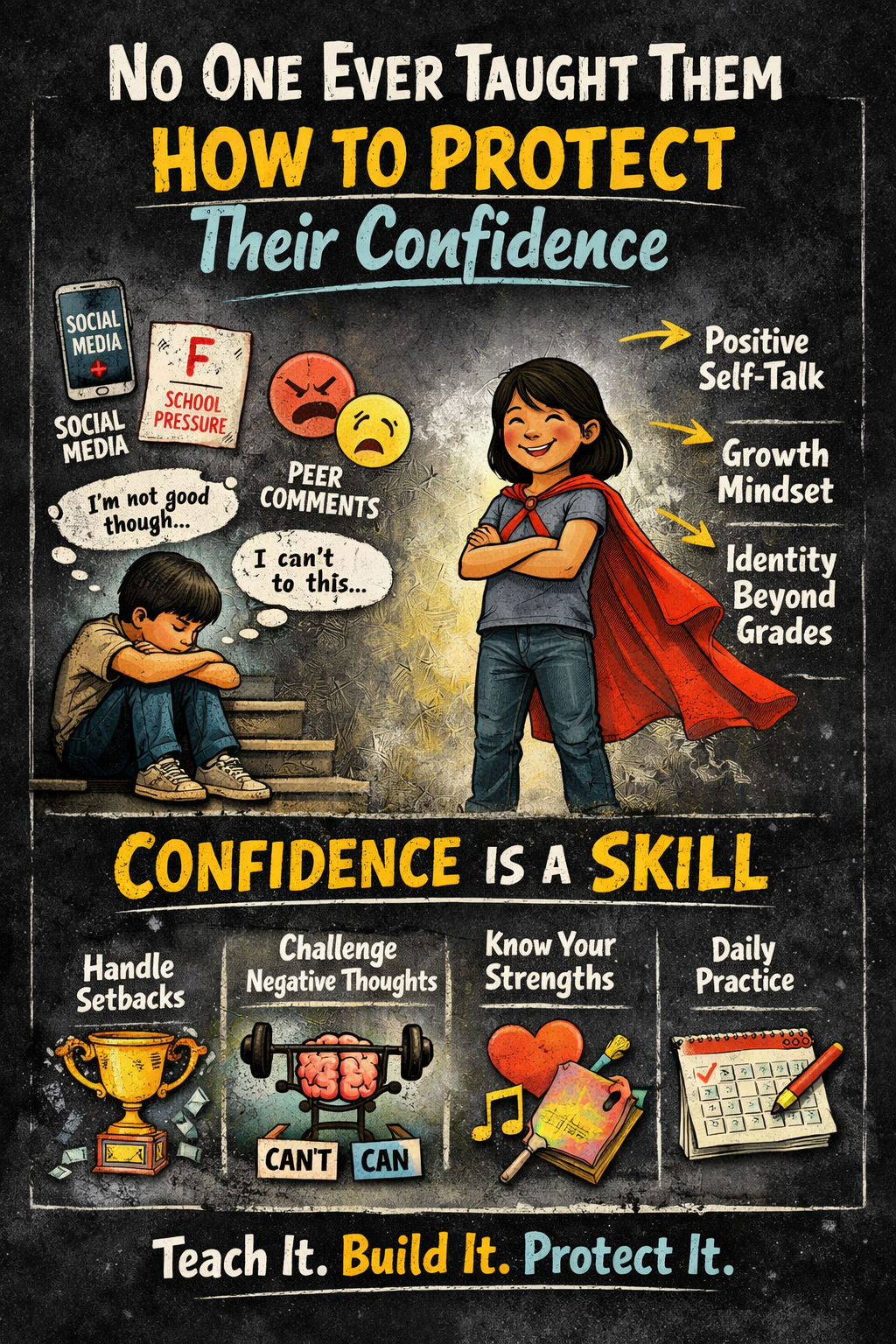
No One Ever Taught Them How to Protect Their Confidence
No One Ever Taught Them How to Protect Their Confidence
by Dr. Michael Arrington
I recently came across a social media post that made me pause:
80% of kids enter 1st grade with high self-esteem.
By 5th grade, only 20% do.
The usual explanations followed.
Puberty.
Social media.
School pressure.
Those things matter—but they’re not the root problem.
They’re accelerants.
After more than 30 years working with young people—elementary through college, special education, juvenile justice, and now therapeutic and school-based behavioral health—I’ve learned something that doesn’t get said enough:
Confidence doesn’t disappear. It gets worn down.
And most children were never taught how to protect it.
Confidence Isn’t a Trait. It’s a Skill.
We often talk about confidence as if it’s something you either have or don’t have. In reality, confidence is built through experience, reinforced through relationships, and shaped by environment.
Children enter school curious, expressive, and unafraid to try. Over time, many learn new rules:
Be right more than you’re curious
Don’t make mistakes publicly
Measure yourself against others
Tie your worth to grades, approval, or performance
By the time students reach upper elementary or middle school, many have internalized a dangerous message:
“If I’m not good at this, maybe I’m not good—period.”
That belief doesn’t come from social media alone.
It comes from unexamined systems, misaligned incentives, and adult silence around emotional development.
What I See in Schools Every Day
As a Therapeutic Behavioral Strategist, I work with students who are often labeled “unmotivated,” “defiant,” or “checked out.”
But when you listen closely, what you hear is this:
Fear of failure
Fear of embarrassment
Fear of not being enough
Many students don’t lack confidence.
They lack confidence recovery skills.
No one taught them how to:
Respond to setbacks
Separate performance from identity
Advocate for themselves
Challenge negative self-talk
Rebuild after disappointment
So instead, they withdraw. Or act out. Or stop trying altogether.
If Confidence Is Learned, It Can Be Taught
Here’s the good news:
Because confidence is learned, it can be intentionally developed.
But it requires us to stop treating social-emotional learning as a “nice add-on” and start treating it as foundational.
1. Teach Kids How to Talk to Themselves
Children internalize the voices around them—teachers, parents, peers—and turn them into their inner dialogue.
We must explicitly teach:
How to recognize negative self-talk
How to challenge distorted thinking
How to replace “I can’t” with “I’m still learning”
This aligns with decades of research on cognitive restructuring and self-efficacy (Bandura, 1997; Dweck, 2006).
2. Normalize Struggle Without Normalizing Shame
Too many classrooms reward correctness and speed while quietly punishing struggle.
Confidence grows when students learn:
Mistakes are information, not identity
Effort matters more than outcome
Growth is nonlinear
When adults model this—especially educators—students internalize resilience rather than perfectionism.
3. Build Identity Beyond Performance
When children only feel valued for grades, behavior, or compliance, their confidence becomes fragile.
We must help them answer:
Who am I beyond my test score?
What do I value?
What am I good at that isn’t graded?
This is especially critical for students from marginalized backgrounds, who often receive more correction than affirmation in school settings.
4. Create Daily Confidence Practices—Not One-Time Assemblies
Confidence doesn’t grow from a single motivational talk.
It grows from:
Daily reflection
Consistent affirmation
Opportunities for voice and leadership
Safe spaces to fail and recover
Just like physical health, emotional confidence requires practice, not slogans.
What This Means for Parents, Educators, and Systems
If we want to reverse the confidence decline we see between 1st and 5th grade, we must:
Embed SEL into the school day—not just discipline systems
Train adults to model emotional regulation and self-compassion
Teach students how to protect their confidence before it’s damaged
Confidence is not about ego.
It’s about self-trust.
And self-trust is one of the greatest protective factors a young person can have.
Final Thought
When a child loses confidence, it’s rarely because they suddenly changed.
It’s because the world taught them something—and no one taught them how to push back.
That’s not a failure of children.
That’s a call to action for adults.
And it’s one we can answer—if we choose to be intentional.
References (APA 7th Edition)
Bandura, A. (1997). Self-efficacy: The exercise of control. W. H. Freeman.
Dweck, C. S. (2006). Mindset: The new psychology of success. Random House.
Harter, S. (2012). The construction of the self: Developmental and sociocultural foundations (2nd ed.). Guilford Press.
Collaborative for Academic, Social, and Emotional Learning. (2020). What is SEL? https://casel.org
Wentzel, K. R., & Miele, D. B. (Eds.). (2016). Handbook of motivation at school (2nd ed.). Routledge.