

Still Waiting: A Contemporary Response to Letter From Birmingham Jail
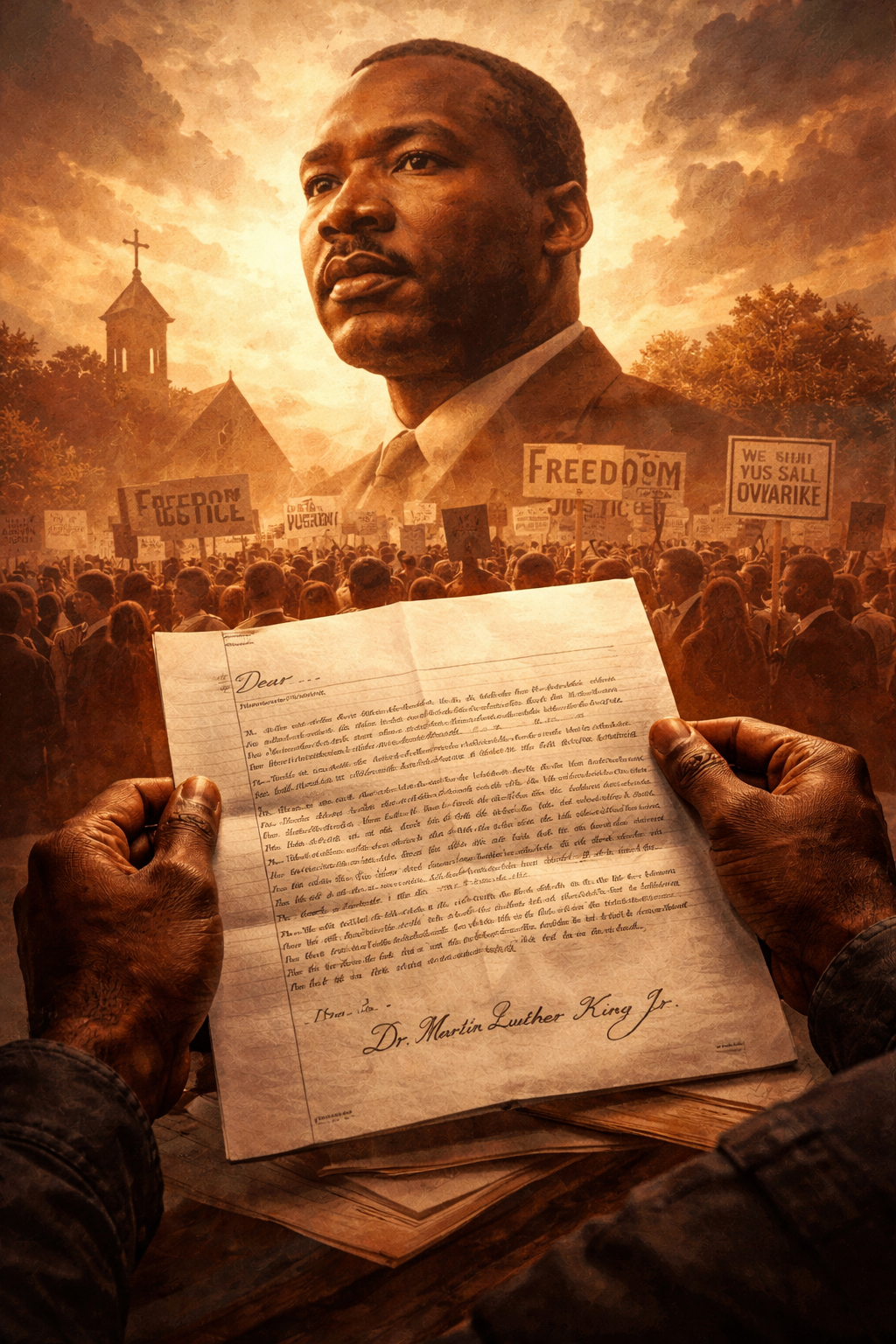
Still Waiting: A Contemporary Response to Letter from Birmingham Jail
Michael E. Arrington, Ed.D.
MEA Training and Program Development, LLC
2026
⸻
Abstract
In Letter from Birmingham Jail, Dr. Martin Luther King Jr. articulated a moral and philosophical framework for understanding injustice, civil disobedience, and the ethical responsibility of institutions. Although written in 1963, King’s arguments remain disturbingly relevant. This essay responds to King’s letter through an analysis of contemporary racialized violence, including the deaths of Trayvon Martin, Tamir Rice, Breonna Taylor, George Floyd, Renee Good and Alex Pretti, as well as the impact of U.S. Immigration and Customs Enforcement (ICE) raids on immigrant communities. Drawing from professional experience in both education and law enforcement, this paper argues that King’s warnings about delayed justice, unjust laws, and institutional complacency remain unresolved and that contemporary systems continue to privilege order over justice. The essay concludes that justice delayed functions as justice denied and that moral neutrality by institutions perpetuates systemic harm.
Keywords: racial justice, civil disobedience, institutional responsibility, law enforcement, education, systemic oppression
⸻
Introduction
When Dr. Martin Luther King Jr. (1963/2018) penned Letter from Birmingham Jail, he sought not only to defend nonviolent direct action but to expose the moral failures of institutions that tolerated injustice under the guise of order and patience. Writing in response to white clergymen who criticized the Birmingham campaign as untimely and extreme, King articulated a timeless critique of moderation, delayed justice, and unjust laws. More than six decades later, the persistence of racialized violence and institutional inaction suggests that King’s letter was not merely historical commentary, but a diagnostic framework for understanding contemporary injustice.
This essay examines King’s arguments in light of modern atrocities involving state and extrajudicial violence against marginalized communities. Through the lens of lived professional experience in both education and law enforcement, this paper explores how institutional allegiance to procedure and order continues to override moral accountability. The central claim advanced here is that King’s critique of delayed justice remains unresolved, as contemporary systems continue to normalize harm while demanding patience from those most affected.
⸻
Delayed Justice and the Illusion of Time
A central theme in Letter from Birmingham Jail is King’s rejection of the notion that oppressed communities should “wait” for justice. King (1963/2018) asserts that “justice too long delayed is justice denied” (p. 90), emphasizing that time itself is morally neutral and must be actively used in service of justice. The concept of waiting has since evolved into calls for investigations, internal reviews, and procedural safeguards that often stall meaningful accountability.
The deaths of Trayvon Martin, Tamir Rice, Breonna Taylor, and George Floyd exemplify how the rhetoric of patience continues to function as a mechanism of control. In each case, the public was urged to wait for facts, to trust institutional processes, and to avoid premature judgment. Yet, as King warned, delay frequently results in diminished accountability and normalized injustice. The repeated invocation of due process without corresponding structural change reinforces King’s assertion that delay serves the interests of the powerful rather than the oppressed.
⸻
Just and Unjust Laws in Contemporary Practice
King’s distinction between just and unjust laws remains one of the letter’s most enduring contributions. Drawing on Augustine and Aquinas, King (1963/2018) defines unjust laws as those that degrade human personality or are imposed without the consent of the governed. Importantly, King argues that individuals have a moral responsibility to disobey unjust laws openly and conscientiously.
From a law enforcement perspective, this distinction exposes a profound ethical tension. Officers are trained to uphold the law, yet King reminds us that legality does not equate to morality. Policies governing stop-and-frisk practices, no-knock warrants, and use-of-force protocols may be legally sanctioned while producing lethal outcomes. The death of Breonna Taylor, killed during the execution of a no-knock warrant, exemplifies how lawful actions can still result in moral catastrophe.
The defense that one was “just following policy” echoes the very institutional logic King critiqued. It reflects an abdication of moral agency in favor of procedural compliance. King’s framework demands a reexamination of professional ethics that places human dignity above institutional loyalty.
⸻
Institutional Silence and the Role of Education
King reserved some of his strongest criticism for institutions that claimed moral authority while remaining silent in the face of injustice. While his immediate audience included religious leaders, the critique extends naturally to educational institutions. As an educator, I have witnessed how systemic injustice manifests in student disengagement, trauma responses, and mistrust of authority.
Students, particularly those from marginalized communities, experience high-profile killings not as isolated incidents but as cumulative evidence that their lives are undervalued. When schools respond with superficial acknowledgments rather than structural change, they mirror the complacency King identified. Teaching civic ideals without modeling moral courage reinforces a hidden curriculum of compliance rather than justice.
⸻
Immigration Enforcement and the Expansion of Injustice
King’s critique of unjust laws also applies to contemporary immigration enforcement practices. ICE raids that separate families, often without warning, perpetuate fear and instability in immigrant communities. Children returning home to find parents detained experience trauma that parallels the racialized harms King described. These practices, though legal, function to dehumanize and marginalize, thereby meeting King’s definition of unjust laws.
The normalization of such enforcement underscores King’s argument that laws targeting specific populations for degradation lack moral legitimacy. Institutional silence in response to these practices further demonstrates how injustice thrives when legality supersedes humanity.
⸻
Conclusion
Letter from Birmingham Jail remains a moral mirror reflecting the unresolved contradictions of American democracy. King’s warnings about delayed justice, unjust laws, and institutional complacency resonate powerfully in the context of contemporary racial violence and immigration enforcement. Drawing from experience in both education and law enforcement, this essay affirms King’s assertion that order without justice is not peace, but controlled harm.
Justice delayed is not a neutral outcome; it is an active choice that preserves existing power structures. King’s letter demands not admiration, but action. Until institutions choose moral accountability over comfort and convenience, the letter from Birmingham remains unanswered.
⸻
References
King, M. L., Jr. (2018). Letter from Birmingham jail. In J. M. Washington (Ed.), A testament of hope: The essential writings and speeches of Martin Luther King, Jr. (pp. 84–100). HarperOne. (Original work published 1963)
Alexander, M. (2020). The new Jim Crow: Mass incarceration in the age of colorblindness (10th anniversary ed.). The New Press.
Crenshaw, K. (2017). On intersectionality: Essential writings. The New Press.
U.S. Department of Justice. (2021). Investigation of the Minneapolis Police Department. Author.