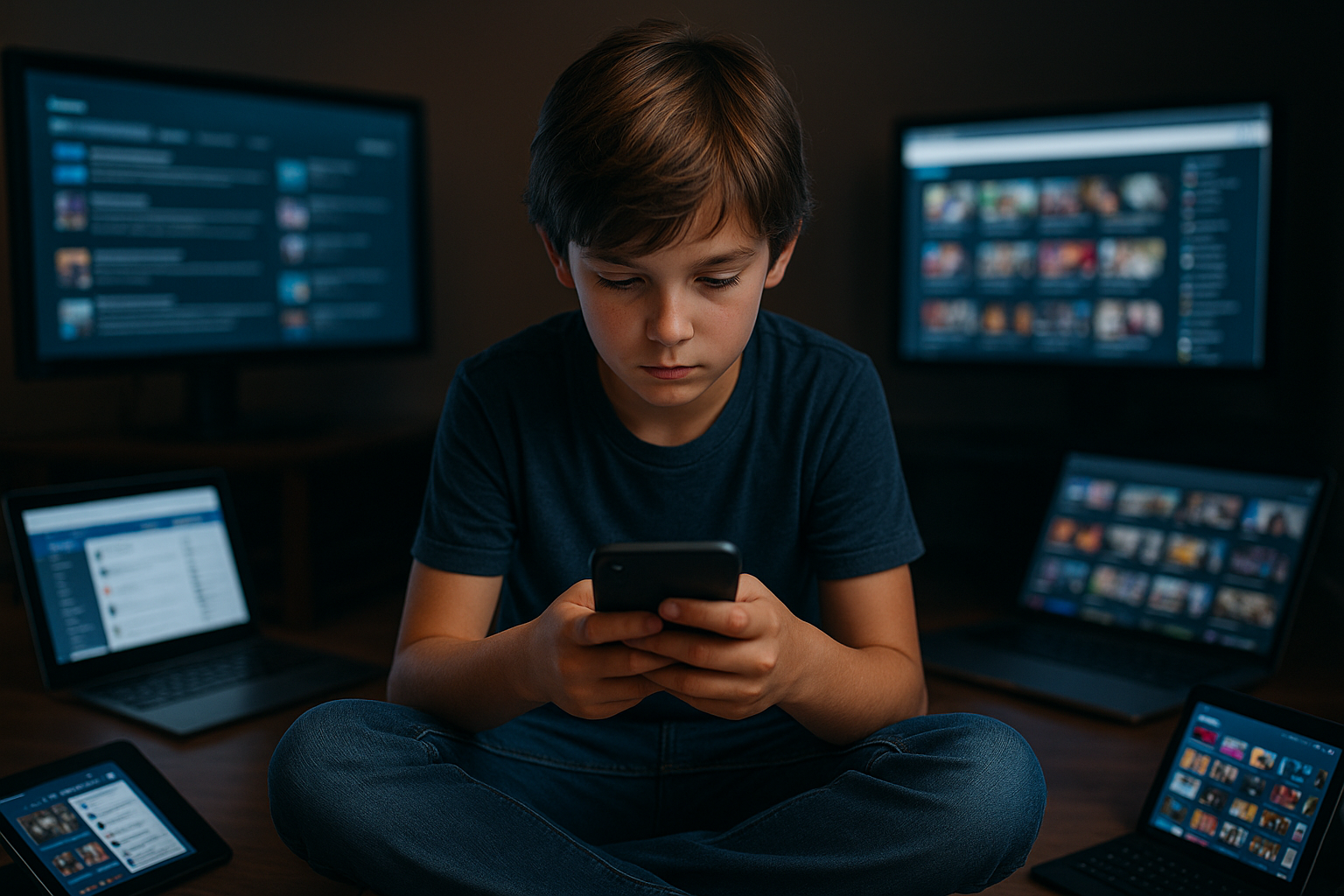
Helping Kids Succeed in a World That Never Stops Scroling
⭐ Helping Kids Succeed in a World That Never Stops Scrolling
Why Today’s Kids Struggle to Pay Attention — And It’s Not Their Fault
By Dr. Michael E. Arrington, Ed.D.
Therapeutic Behavioral Strategist • Consultant • Father
If you grew up in the ’80s or ’90s, your childhood was radically different from what our kids are experiencing today. Not just in culture — but in how your brain was shaped.
We waited for things.
📺 Our favorite shows came on once a week.
🎮 Video games had levels to beat, and failure was part of the journey.
📷 Photos took days to develop, not seconds to swipe.
☎️ We talked on one phone in the kitchen…and everyone could hear you.
Delays weren’t a frustration — they were a normal part of life.
And every delay built something powerful:
Frustration tolerance. Focus. Patience. The ability to stick with a challenge.
These are essential skills for success in school, relationships, and life.
A New Generation, A New Brain
Our kids are growing up in a world where nothing waits.
Games never end
There is always a next level
Notifications interrupt constantly
Every song, show, and video is available now
And their entertainment is designed to:
✔️ Stimulate
✔️ Reward instantly
✔️ Keep them coming back
Dopamine — the brain’s reward chemical — used to be earned through effort.
Now it’s delivered on demand.
This is not about parenting styles or “kids these days.”
This is about brain wiring.
Children don’t lack focus. Their brains are focused on what the world has trained them to focus on.
Stimulation. Novelty. Speed.
It’s not a character flaw — it’s neuroscience.
The Attention Gap
Here’s what we’re seeing in schools and homes across the country:
🚩 Shorter attention spans
🚩 Anxiety when gratification isn’t instant
🚩 Difficulty completing multi-step tasks
🚩 Lower frustration tolerance (“This is too hard!”)
🚩 Avoidance of challenging work
🚩 “Boredom feels painful”
When everything is fast…
Slow feels like failure.
And when games reward constant success…
School — where learning involves struggle — can feel overwhelming.
We Must Lead with Empathy — Not Shame
Parents and teachers often feel frustration:
“Why won’t they stick with anything?”
“Why can’t they just focus?”
“Why do they melt down when it gets hard?”
Here’s the truth:
Kids are not choosing distraction — distraction is choosing them.
This generation is swimming in a digital current we didn’t have to face.
They deserve understanding.
They deserve patience.
They deserve strategies that meet them where they are.
So How Do We Help Them Build What They Missed?
Here are practical, compassionate approaches:
1️⃣ Reintroduce “Healthy Boredom”
Boredom is the brain’s creativity engine.
Let kids sit with it — without instantly rescuing them with screens.
Try:
A 10-minute “boredom break”
Art supplies or building toys nearby
Outdoor time with no planned activity
2️⃣ Gamify the Hard Stuff
If games motivate them — use that!
Examples:
Homework “levels” they can beat
Timer challenges (“Focus for 8 minutes — can you level up to 10?”)
Sticker or point systems with delayed rewards
3️⃣ Praise the Process, Not the Product
Instead of “You’re so smart,” try:
“You stuck with that even when it was tough.”
“I noticed how you tried different strategies.”
This builds resilience.
4️⃣ Teach Frustration Tolerance Intentionally
Normalize discomfort:
“This feels hard because your brain is growing.”
Celebrate retries —
every video game hero starts by losing.
Schools & Families Can Partner — Not Point Fingers
Kids thrive when:
Expectations are consistent
Adults communicate
Screens are balanced with human connection
Imperfection is allowed
The goal isn’t to eliminate technology —
It’s to equip children to navigate it.
They can learn the skills we developed naturally —
but we must teach them on purpose.
Why I Care About This Work
As a father and an educator, I’ve seen both worlds.
I’ve worked with:
Students who fold under pressure
Students who flourish once someone slows the world down for them
Families who just want help understanding their children
And I believe this wholeheartedly:
Every child can learn to focus.
Every child can learn to persevere.
Every child can succeed — even in a scrolling world.
But they need us to guide them.
What’s Coming Next
This is Part 1 of a 12-part series called:
Rewired: Growing Up Then vs. Now
Together, we’ll explore:
The science of dopamine and attention
The lost art of boredom
Classroom and home strategies for success
How to rebuild attention stamina and resilience
How we can empower kids — not blame them
Follow along as we help kids rewire for resilience.
📌 Share this with a parent or teacher
🔔 Subscribe for the next installment
🌐 Learn more & book consultation: MichaelArrington.education
Let’s equip this generation for a future that demands focus, creativity, and courage.
We can’t slow the world down —
but we can help every child rise above the scroll.
References
Bavelier, D., Green, C. S., & Dye, M. W. G. (2019). Children’s brains and digital media: A cognitive neuroscience perspective. JAMA Pediatrics, 173(10), 999–1000. https://doi.org/10.1001/jamapediatrics.2019.2621
Christakis, D. A. (2019). The challenges of defining and studying “digital addiction” in children. JAMA Pediatrics, 173(10), 1002–1003. https://doi.org/10.1001/jamapediatrics.2019.2620
Kostyrka-Allchorne, K., Cooper, N. R., & Simpson, A. (2017). The relationship between television exposure and children’s attention abilities: A systematic review. Developmental Review, 44, 19–39. https://doi.org/10.1016/j.dr.2016.12.002
Lillard, A. S., Drell, M. B., Richey, E. M., Boguszewski, K., & Smith, E. D. (2015). Media use and executive function in preschoolers. Psychology of Popular Media Culture, 4(4), 444–460. https://doi.org/10.1037/ppm0000031
Nuyens, F., et al. (2023). Gaming, reward systems, and impulsivity: Understanding the dopamine connection. Computers in Human Behavior, 139, 107536. https://doi.org/10.1016/j.chb.2022.107536
Patton, G. C., Sawyer, S. M., Santelli, J. S., Ross, D. A., & Viner, R. M. (2018). Our future: A Lancet commission on adolescent health and wellbeing. The Lancet, 387(10036), 2423–2478. https://doi.org/10.1016/S0140-6736(16)00579-1
Romer, D., Bagdasarov, Z., & More, E. (2022). The role of digital media in attention-deficit/hyperactivity disorder symptoms. Clinical Child and Family Psychology Review, 25, 35–56. https://doi.org/10.1007/s10567-021-00362-9
Uhls, Y. T., & Greenfield, P. M. (2019). The rise of media multitasking: How digital media changes cognitive development. Oxford Research Encyclopedia of Psychology. https://doi.org/10.1093/acrefore/9780190236557.013.445
Wilmer, H. H., Sherman, L. E., & Chein, J. M. (2020). Smartphones and cognition: A review of research exploring the links between mobile technology habits and cognitive functioning. Frontiers in Psychology, 11, 605684. https://doi.org/10.3389/fpsyg.2020.605684
About Dr. Michael E. Arrington
Dr. Arrington is a Therapeutic Behavioral Strategist, educational consultant, author, and father. He works with schools and families to improve student behavior, build positive school climate, and cultivate social-emotional strengths that help every child thrive.