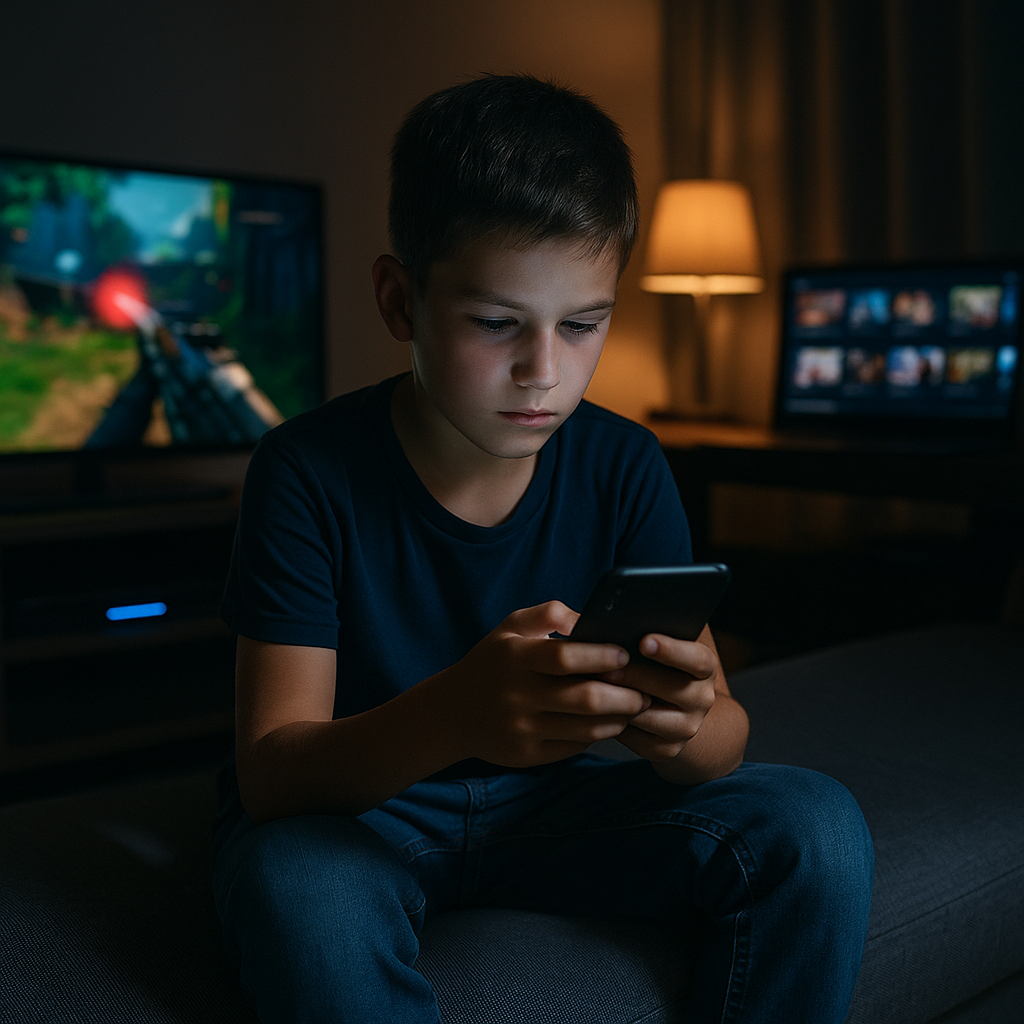
Dopamine on Demand: Gaming, Binge-Watching & the Overstimulated Brain
Dopamine on Demand: Gaming, Binge-Watching & the Overstimulated Brain
Helping kids succeed in a world that never stops scrolling.
By Dr. Michael E. Arrington, Ed.D.
Therapeutic Behavioral Strategist • Consultant • Father
⸻
In the ’80s and ’90s, entertainment came with built-in limits.
If you wanted to play your favorite video game, you had to beat the level or start over.
If you wanted to watch your show, you had to wait until next week.
If you wanted a new movie, you had to drive to the video store and hope it wasn’t already rented out.
Every delay trained the brain to wait, adapt, and persist.
Today?
Video games never end.
Streaming never stops.
Social media endlessly refreshes.
And all of it is designed to keep kids coming back.
⸻
Why the Brain Loves “Just One More”
Our brains are wired to seek pleasure, novelty, and reward.
That’s dopamine’s job — the chemical that says, “This feels good. Do it again.”
Modern media has mastered dopamine.
• New level achieved → dopamine
• New “skin” → dopamine
• New video auto-plays → dopamine
• New notification → dopamine
This constant reward schedule activates the brain’s learning loop repeatedly, making stoppingmuch harder than starting (Nuyens et al., 2023).
Kids aren’t being “defiant.”
They’re being reinforced — powerfully.
⸻
When Everything is Instant, Waiting Feels Wrong
In learning environments, dopamine is traditionally experienced after effort — finishing a paper, solving a problem, winning a game.
Today’s tech flips that:
Reward first. Effort optional.
Research shows that rapid-fire digital stimulation can reduce attention stamina, especially when a task requires sustained mental effort (Bavelier et al., 2019; Wilmer et al., 2020).
That makes classrooms — where focus grows slowly — feel like trying to run underwater.
Parents see the tension at home:
“Why can they play games for hours but can’t focus for 10 minutes on homework?”
It’s not a choice.
It’s neurochemistry.
⸻
What Happens When the Feed Never Ends?
Studies show constant digital access is linked to:
• Increased impulsivity (Romer et al., 2022)
• Difficulty transitioning away from screens (Christakis, 2019)
• Lower frustration tolerance (Uhls & Greenfield, 2019)
• Anxiety and irritability when stimulation stops (Patton et al., 2018)
Kids often describe boredom as painful.
But that’s because the brain has been trained to avoid it.
⸻
Empathy First: Our Kids Are Not Broken
It’s easy for adults to say:
“When I was your age…”
But our kids never got the chance to develop the patience and boredom skills we learned by default.
Their environment delivers stimulation at a pace their brains were not evolved to handle (Lillard et al., 2015).
So when they feel anxious, unfocused, or overwhelmed, they deserve support, not shame.
⸻
What Parents & Educators Can Do
Here are strategies to gently rewire reward pathways:
⸻
1️⃣ Create dopamine-neutral spaces
Preferably daily:
• Outdoor play
• Physical activity
• Quiet reading
• Mindful breathing
• Art or building materials
No pings. No pop-ups. No autoplay.
These moments help reset the brain’s baseline reward.
⸻
2️⃣ Use Tech Rules that Build Regulation, Not Punishment
Try:
• Boundaries with explanations
“Screens down at 8pm because sleep helps your brain grow.”
• Predictable schedules
Kids do better when limits are clear.
• Finish responsibilities first → then screen time
Builds tolerance for delayed gratification.
⸻
3️⃣ Celebrate Challenge
Kids need situations where success isn’t instant.
Praise effort and persistence more than outcomes:
“You kept trying even when it got tough. That’s how your brain gets stronger.”
Difficulty should feel normal — not threatening.
⸻
4️⃣ Teach “Stop Power”
Practice transitions:
• 5-minute warnings
• Visual timers
• Collaborative agreements
Stopping becomes easier when it’s not sudden or adversarial.
⸻
We Can Rewire for Resilience
Technology isn’t the villain.
Dopamine isn’t the villain.
The villain is lack of balance.
We can help kids learn to:
• Delay gratification
• Tolerate boredom
• Thrive without constant stimulation
• Find joy in progress, not just rewards
This is a skill — and skills can be taught.
With patience.
With relationship.
With understanding.
⸻
Coming Up Next
Part 3 — “The Lost Art of Boredom: Why Kids Need It Back”
We’ll dive into:
• How boredom strengthens creativity
• Why unstructured play is essential again
• How schools and families can build this skill gradually and compassionately
⸻
📚 References (APA 7th Edition)
Bavelier, D., Green, C. S., & Dye, M. W. G. (2019). Children’s brains and digital media: A cognitive neuroscience perspective. JAMA Pediatrics, 173(10), 999–1000. https://doi.org/10.1001/jamapediatrics.2019.2621
Christakis, D. A. (2019). The challenges of defining and studying “digital addiction” in children. JAMA Pediatrics, 173(10), 1002–1003. https://doi.org/10.1001/jamapediatrics.2019.2620
Lillard, A. S., Drell, M. B., Richey, E. M., Boguszewski, K., & Smith, E. D. (2015). Media use and executive function in preschoolers. Psychology of Popular Media Culture, 4(4), 444–460. https://doi.org/10.1037/ppm0000031
Nuyens, F., et al. (2023). Gaming, reward systems, and impulsivity: Understanding the dopamine connection. Computers in Human Behavior, 139, 107536. https://doi.org/10.1016/j.chb.2022.107536
Patton, G. C., Sawyer, S. M., Santelli, J. S., Ross, D. A., & Viner, R. M. (2018). Our future: A Lancet commission on adolescent health and wellbeing. The Lancet, 387(10036), 2423–2478. https://doi.org/10.1016/S0140-6736(16)00579-1
Romer, D., Bagdasarov, Z., & More, E. (2022). The role of digital media in attention-deficit/hyperactivity disorder symptoms. Clinical Child and Family Psychology Review, 25, 35–56. https://doi.org/10.1007/s10567-021-00362-9
Uhls, Y. T., & Greenfield, P. M. (2019). The rise of media multitasking: How digital media changes cognitive development. Oxford Research Encyclopedia of Psychology.https://doi.org/10.1093/acrefore/9780190236557.013.445
Wilmer, H. H., Sherman, L. E., & Chein, J. M. (2020). Smartphones and cognition: A review of research exploring the links between mobile technology habits and cognitive functioning. Frontiers in Psychology, 11, 605684. https://doi.org/10.3389/fpsyg.2020.605684